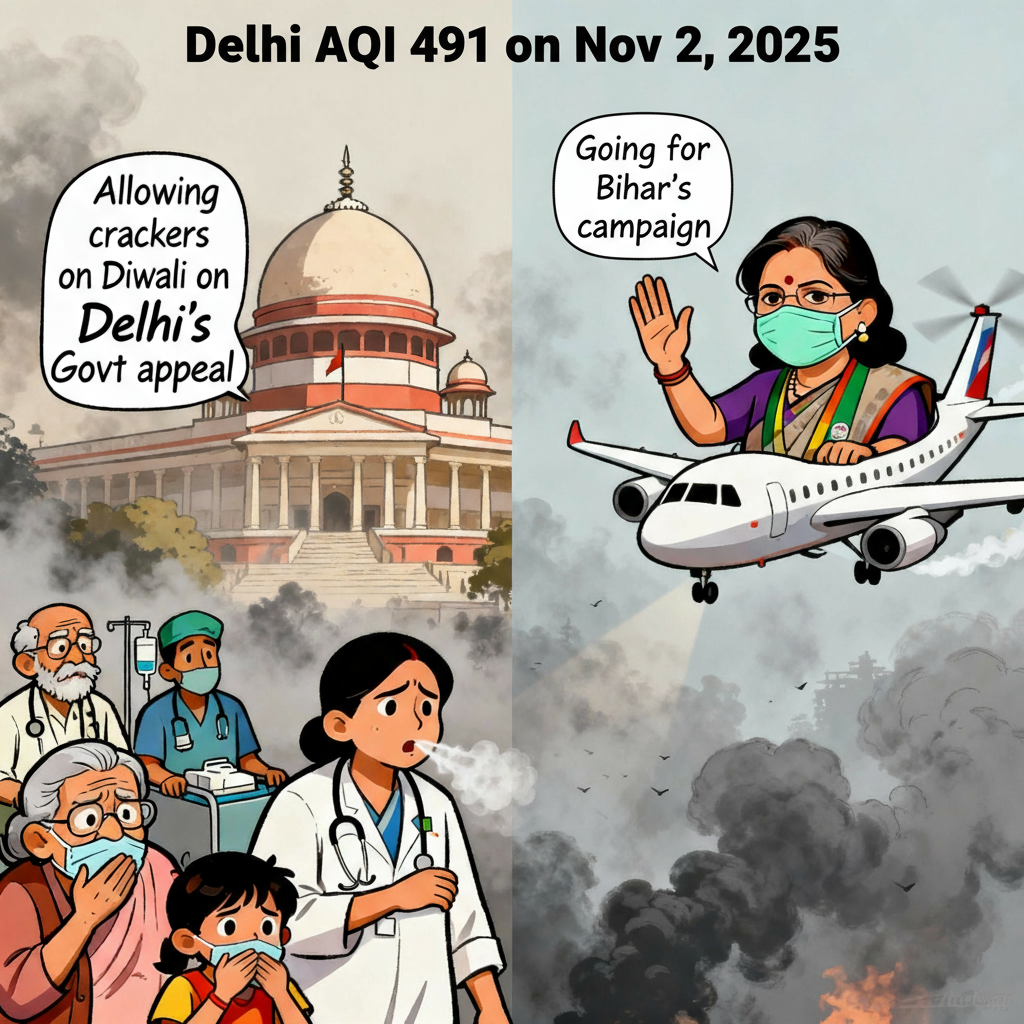
Delhi air pollution Hits Deadly Peak, posing severe health risks to its residents, while Chief Minister Rekha Gupta is heavily engaged in campaigning for the Bihar Assembly elections, but silent on Delhi air pollution, raising concerns about her attention to Delhi’s environmental crisis.
The trend shows that Delhi is currently in a very challenging pollution phase typical of early November, marking the beginning of a historically most polluted fortnight. Seasonal factors like stubble burning, vehicle emissions, and weather conditions contribute significantly to pollution spikes.
Delhi Air Pollution AQI : 491

1st Nov 25 : Delhi’s AQI 303 : Very Poor Category
Recent reports show that Delhi’s Air Quality Index (AQI) has surged sharply, reaching very poor to severe levels. On November 1, 2025, Delhi’s AQI was recorded at 303, a sharp increase from 218 the previous day, pushing the city deep into the “very poor” category.
2nd Nov 25 : Delhi’s AQI 491 : Severe Plus Category
On November 2, 2025, the AQI reportedly peaked to 491, forcing the government to enforce restrictions on vehicular movement to curb pollution levels. Persistent high pollution levels cause widespread health impacts including increased respiratory illnesses, lung diseases, and long-term exposure consequences.
Delhi’s current Air Quality Index (AQI) reading as of November 2, 2025, at 5:47 PM local time is 190, categorized as “Unhealthy.” The particulate matter concentrations are PM2.5 with 110 µg/m³ and PM10 with 142 µg/m³. The AQI has fluctuated during the day, with the worst reading reaching 444 (Hazardous) in the morning and the best around 181 (Unhealthy) in the afternoon. The temperature is 27°C with 42% humidity and a wind speed of 10 km/h.
Leave Delhi temporarily to avoid severe health repercussions.

Health Advisory for Delhi air pollution AQI
- Good (0-50): Minimal impact. Enjoy outdoor activities freely.
- Satisfactory (51-100): Minor irritations for sensitive groups. Sensitive individuals should take caution.
- Moderate (101-200): Respiratory symptoms possible in sensitive groups. Limit prolonged outdoor exertion.
- Poor (201-300): Increased respiratory issues and aggravation of heart/lung diseases. Avoid outdoor activities and wear masks.
- Very Poor (301-400): Higher risk of respiratory illness and eye irritation. Minimize outdoor exposure and use air purifiers indoors.
- Severe (401-500): Serious health effects, emergency conditions for vulnerable groups. Stay indoors, use N95 masks, avoid outdoor exertion, monitor symptoms closely, and seek emergency care if needed.
- Severe+ (>500): Critical health emergency. Avoid all outdoor activities and follow emergency response measures.
This advisory summarizes the precautions residents should take at each pollution level for maximum safety and health protection.
Health Risks to Delhi Residents
Health advice for this AQI level includes limiting outdoor activities, especially for sensitive groups such as children, elderly, and those with respiratory conditions. Use of air purifiers indoors and N95 masks outdoors is strongly recommended. The Delhi air pollution is severe enough that it’s comparable to smoking 10 cigarettes per day in terms of health impact
- Pulmonologists have advised vulnerable populations to leave Delhi temporarily to avoid severe health repercussions.
- Air pollution has become Delhi’s biggest killer:
- contributing to about 15% of all deaths in the city.
- Significant instances of respiratory issues, especially among children, including diminished lung growth and high asthma rates.
- The pollution exposes residents to viral and bacterial pneumonia risks, with high mortality rates among vulnerable groups.
- Experts note both short- and long-term detrimental effects on lung function and overall health systems due to the toxic air.
Why CM Rekha Gupta is Silent on Delhi Air Pollution Now?
Chief Minister Rekha Gupta’s relative silence on Delhi air pollution severe situation over the last week can be attributed to several reasons:

Delhi’s CM is Busy in Bihar’s Elections
While Delhi grapples with these alarming pollution levels, CM Rekha Gupta has been actively involved in campaigning for the Bihar Assembly elections. Since February 2025, Rekha Gupta has been the Chief Minister of Delhi and is now a key figure in Bihar’s poll campaign. She has been traveling to Bihar to attend nomination filings and address several public meetings, including Lakhisarai and Bihar Sharif, supporting BJP candidates and campaigning for multiple days ahead of the Bihar polls.
Delhi BJP leaders, including CM Rekha Gupta, have taken up election duties in Bihar due to the significant Purvanchali voter base in Delhi and BJP’s strategy to strengthen its position in Bihar. CM Gupta is expected to devote at least six days to campaigning, partially during the crucial polling phases, which has raised concerns about the administrative focus back in Delhi air pollution.
Downplaying the Crisis when Delhi Chokes in Silence: Air Pollution Hits Deadly Peak
Rekha Gupta has stated that pollution levels in 2025 are actually lower compared to previous years despite the worsening situation on the ground. She claimed that the pollution after Diwali this year was lower than last year and attributed this partly to relaxations in cracker burning regulations and various government measures. This stance has been seen by some as an attempt to downplay the crisis rather than acknowledge the severe health risks currently faced by Delhi residents.
Government’s Ongoing Efforts Highlighted (Efforts that are not useful at all)
When she does comment, Rekha Gupta emphasizes ongoing government initiatives such as cloud seeding for artificial rain, deployment of electric vehicles, anti-smog guns, and water sprinklers aimed at mitigating pollution. She also launched an Air Pollution Mitigation Plan emphasizing long-term solutions including greening Delhi and controlling vehicular emissions. These messages appear to shift focus to preventive and structural measures rather than immediate admissions of crisis severity on Delhi air pollution.
Political Sensitivity and Image Management
As a new Chief Minister since early 2025, Gupta has political incentives to project confidence and control rather than alarm. Minimizing appearances of a major failure like worst-ever Delhi air pollution surge may be considered a strategic communication choice while efforts to tackle pollution continue behind the scenes.
Delhi’ Govt contributed in air pollution by asking Supreme Court to allow fire crackers on Diwali
The Delhi government’s decision to seek the Supreme Court’s permission to allow the sale and use of green firecrackers during Diwali has significantly contributed to the Delhi air pollution crisis. Despite the ban on traditional firecrackers, the Supreme Court, guided by the Delhi government’s appeal, relaxed restrictions and permitted green crackers under strict conditions for five days during the festival. However, the overwhelming volume of even these supposedly eco-friendly crackers led to severe spikes in particulate matter levels, pushing pollution to dangerously high levels immediately after Diwali. The post-Diwali air quality data showed toxic pollution levels off the charts, with many monitoring stations reporting hazardous conditions, underscoring the serious health risks caused by this policy decision.
In summary, Rekha Gupta’s muted public statements on the recent worsening Delhi air pollution levels stem from a combination of downplaying the issue, shifting focus to government initiatives, engaging in election campaigns, countering political criticism, and managing political optics in a highly sensitive environment.




Be First to Comment